
A Lesson in Wealth That Started With Designer Jeans
How a lesson from Sharon Lechter brought me back to what my mom taught me about money long before I became a CFO.
By Tina O'Banion | Founder & CEO, TFO Clarity
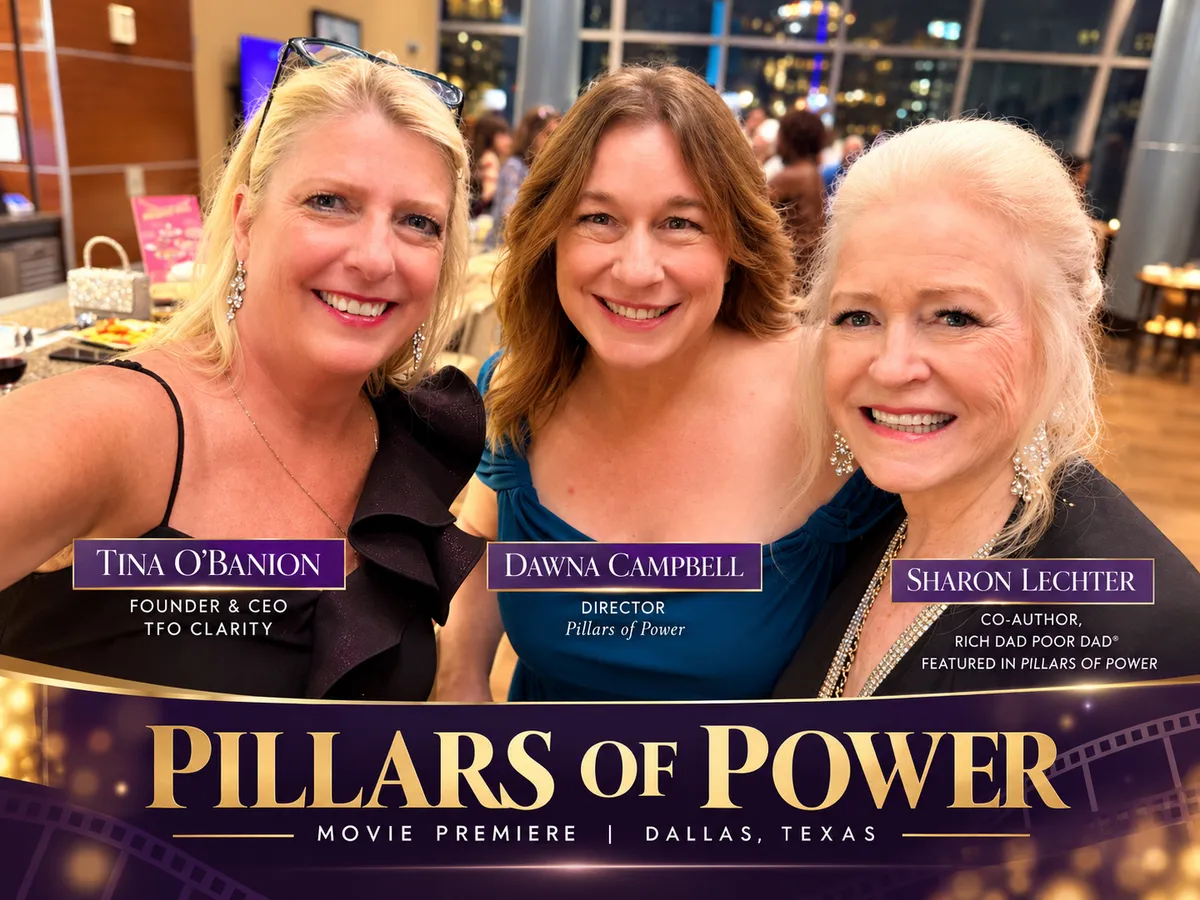
Last night, I attended the Dallas premiere of Pillars of Power, a documentary that explores abundance across different areas of life, including health, relationships, purpose and wealth.
I enjoyed seeing people I knew, meeting new people and celebrating director Dawna Campbell and everyone involved in bringing the film to life. But one moment in particular took me right back to a lesson my mom taught me about money decades ago.
Sharon Lechter, whom I've known for more than two years, spoke about a simple shift in the way we think about money. Instead of saying, "I can't afford it," ask: "How can I afford it?"
Those six words immediately took me back to my childhood and to my very first money teacher: my mom.
My First Money Teacher
My mother was a single parent raising me on a bookkeeper's salary. We didn't have unlimited money, but she never taught me to believe that wanting something better was automatically out of reach.
I remember wanting a pair of designer jeans. My mom was willing to buy what she could reasonably afford, but if I wanted to "buy up," I had to figure out how I was going to pay the difference.
She didn't simply say, "We can't afford it." She put the choice back in my hands.
If I wanted something more expensive, how could I earn the difference? Was it worth it to me? What was I willing to do to make it happen?
At the time, I certainly wasn't thinking about money mindset, entrepreneurship or financial strategy. I just knew that if I wanted the jeans, I needed to figure it out.
From an IOU Money Box to McDonald's
That wasn't the only money lesson my mom gave me.
We had an IOU money box. I babysat to earn money. And at 15, I started working at McDonald's.
The message was consistent: money represented choices, and choices came with responsibility.
If I wanted more, I could find a way to earn more. If I chose to spend money on one thing, I understood that I might not have it available for something else. And if something mattered enough to me, I could look for a solution instead of stopping at "I can't."
Looking back, I can see how much those early lessons shaped the way I think about money today and probably even the CFO I eventually became.
But Today, I'd Add One More Question
Sharon's question is powerful: "How can I afford it?"
It moves us away from an automatic no and toward possibility, creativity and resourcefulness.
But after nearly 30 years working in finance, I'd add one more question: "Should I afford it?"
Because those are two very different questions.
You can often find a way to afford something. You can use cash. You can borrow. You can finance it. You can negotiate. You can delay another expense. You can increase revenue. You can bring in an investor.
The real financial question is whether doing it makes sense.
What will it do to cash flow? What return should you expect? How long is the payback period? What assumptions have to be true for the decision to work? What happens if revenue comes in 20% below plan? What else could that cash be used for? Does the decision move you closer to your goals?
CEOs Need Both Questions
I see this every day with business owners.
Maybe the opportunity is a new location. A key hire. A piece of equipment. A major marketing investment. A new product line. An acquisition.
The first question shouldn't automatically be, "We can't afford it."
Ask: "How could we afford it?" Then bring in the numbers and ask: "Should we?"
That is where financial clarity changes the conversation.
Financial Clarity Isn't About Saying No
A great CFO isn't there simply to tell a CEO no.
The job is to help the CEO understand the financial story well enough to make an informed decision.
Sometimes the answer is yes. Sometimes it's not yet. Sometimes it's yes, if we change a few things first. And sometimes the numbers tell us that the opportunity simply isn't worth the tradeoff.
That's very different from running the business from the bank balance or making a decision based entirely on gut instinct.
Possibility matters. But possibility without financial clarity can get expensive.
Mom Had It Right All Along
Long before my accounting degree, long before I became a CFO, long before I founded TFO Clarity or created the C.L.A.R.I.T.Y. Method, my mom was teaching me a lesson I still use today.
She didn't give me a lecture about scarcity or abundance. She gave me something much more practical: if you want to buy up, figure out how you're going to pay the difference.
That lesson followed me from the IOU money box, to babysitting, to my first job at McDonald's, and eventually into a career spent helping business owners understand their numbers and make better decisions.
Hearing Sharon's words at Pillars of Power brought that lesson right back to me.
“How can I afford it?” teaches resourcefulness.
“Should I afford it?” teaches financial clarity.
Possibility matters. So does clarity.
And Clarity Changes Everything.
About Tina O'Banion
Tina O'Banion is the Founder and CEO of TFO Clarity, The Financial Office, and author of The C.L.A.R.I.T.Y. CODE. TFO Clarity helps founder-led businesses gain confidence in their numbers through accounting, Controller and fractional CFO services. Tina is also the creator of the C.L.A.R.I.T.Y. Method, a practical framework for helping business owners understand their financial position, make better decisions and lead with confidence.
Want to know where your financial gaps may be? Take the Financial C.L.A.R.I.T.Y. Assessment to establish your baseline and identify your biggest opportunity for greater financial clarity.

